5th
June 2025,
It seems as if few trips out in a car (I generally only drive one day a
week) don't experience some issue (usually some minor thing that "I need
to address at some point"). Last month had the distributor cap failure
[see below] and this is a continuation of that.
I had replaced the distributor cap but I had come to decide that I
should have replaced the rotor arm too; "they wear together" ChatGPT
later confirmed. The car, prior to the distributor cap failing, had been
somewhat "lurchy" when holding a steady speed on a flat road. I thought
the replacement cap had improved this but in addition to this it wasn't
quite starting the same. So I set about sourcing a replacement rotor
arm.
The first one that arrived was blatantly the wrong one (perhaps for a
"V6 Essex engine" not a 1.6 Pinto with Bosch* distributor).
*I used ChatGPT throughout this saga to both educate me and try and
suggest parts; it wasn't much use on the latter and would tend to fire
back a part I had told it about as if it had sourced that snippet of
information on its own.
Then I found rotor arms labelled exactly for my engine and
distributor... so that must be correct, right?
There were noticeable differences; could these be overlooked and deemed
to be simply a different manufacturer's way of doing things?
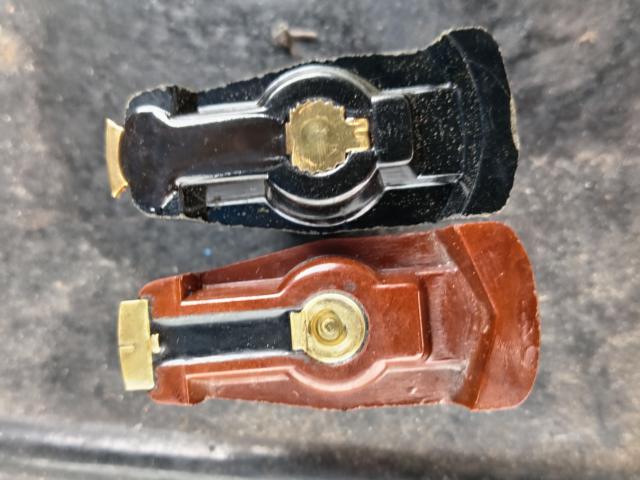
Top, Lucas-branded, bottom, Beru (originally fitted)
I installed the part and started the car and went out for a drive.
Things seemed fine, improved in fact, but then there was a small misfire
some 10 miles later when I pulled into an industrial estate, and then a
stall and a slight struggle to restart when I came to slowly back out of
a parking space on tick-over; "perhaps nothing unusual" I thought...
But then things started to deteriorate further; a loss of power if I
stuck my foot down, and further stallings whenever I had to stop
suddenly, and the car becoming increasingly difficult to start again. I
rolled back only my drive (literally, because the car had cut out
again), and set to diagnosing the issue.
In proceeding to check the leads it seemed to me that the exhaust
manifold was noticeably hot, like a furnace that I didn't want to get my
hands near to reach for the plug leads. I recalled that one of the guys
who had helped me with my car when I broke down last month due to the
failed distributor cap had commented on the engine being "hot", I just
thought this was nothing beyond expected given it was a hot day and I'd
driven around 100 miles. But now I noticed it too, even though then I
managed to tinker with things, and now I didn't want to get near it, so
perhaps it was hotter still.
I consulted ChatGPT about this; the heat and running issues, and it
suggested the timing was off, causing combustion to happen in the
exhaust manifold instead of where it's supposed to. Since all that had
changed, as far as I knew, was that I'd fitted this new rotor arm; I
guessed the different style was indeed the issue and I researched this
further.
In addition to the heat, there was now a noticeable problem within the
new distributor cap; the plastic on one edge of each of the four
contacts was chipped away. I couldn't see how the rotor arm could have
collided with this area to cause the damage, but instead it must have
been the spark.
From my understanding the replacement original rotor arm (which is what
I was trying to use) would have had a resistor in it, but because the
original set of points had been replaced with an "AccuSpark" ignition
system, that setup included a different rotor arm (a "red rotor"), and
these are for the higher performance spark the AccuSpark system
provides, and lack the resistor. I tried to check continuity and
resistance with my multi-meter but this read that each rotor arm I now
had was simply open circuit, even though they did work to some degree. I
needed to find the correct rotor arm.
The original rotor arm on the car was a Beru EVL 4/6-0 FB and I had been
trying to find an equivalent due to cost and availability. I think that
might be a discontinued part. ChatGPT suggests 4/6 simply indicates is
is for 4/6 cylinder engines. Beru's own website claims they supply rotor
arms "With/without 1 kOhm — 5 kOhm interference", so perhaps the "0" in
the model number implies no resistor. Their part finder provides no
rotor arms for my car and has scant information on the Beru EVL 104 I
have chosen to order from ebay. It looks right, but I won't know until I
receive it and try it.
Oh, and once again I managed to pull one of the leads off its end...
luckily I still had a long-enough spare from the ones I replaced last
time, after I did the same thing (and I was being careful too).
|