|
 Or should that be
"Organizers"(1) or "Personal
Organizers"(2), or "PDAs"(3),
or Digital Diary(4)? Or should that be
"Organizers"(1) or "Personal
Organizers"(2), or "PDAs"(3),
or Digital Diary(4)?
1 -
Because I'm British (even though
the devices in question may have
Americanized labelling).
2 -
"Personal organizers" might
mistakenly refer to the paper
versions, such as the Filofax.
3 -
PDAs, or Personal Digital
Assistants are more capable
devices, such as a Compaq iPaq,
or a Psion.
4 - ...as per my most recent
acquisition, a Casio SF-8000
'Digital Diary'.
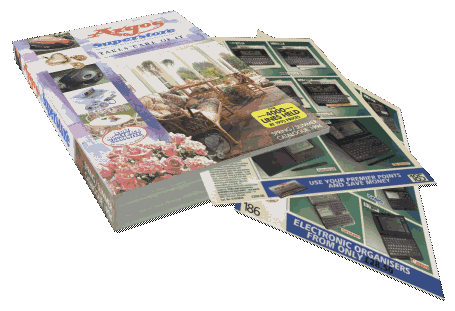
 Electronic organisers were in
in the 1990s and being a youth
of the 90s, and British, the
Argos catalogue was my staple
for impending birthdays and
Christmases. My siblings and I
would eagerly await the
bi-annual release of a new
catalogue so we could start
dreaming of and listing all the
things we'd like to have, not
always from the children's toys
sections, but anything from
furniture for our future homes,
to electronics and gadgetry. Electronic organisers were in
in the 1990s and being a youth
of the 90s, and British, the
Argos catalogue was my staple
for impending birthdays and
Christmases. My siblings and I
would eagerly await the
bi-annual release of a new
catalogue so we could start
dreaming of and listing all the
things we'd like to have, not
always from the children's toys
sections, but anything from
furniture for our future homes,
to electronics and gadgetry.
A rendition, by me, of the
Spring/Summer 1994 catalogue
from
issuu.com |
I wanted an electronic
organiser; they looked cool, and
with memory capacity increasing
year on year I wanted a decent
one...
The
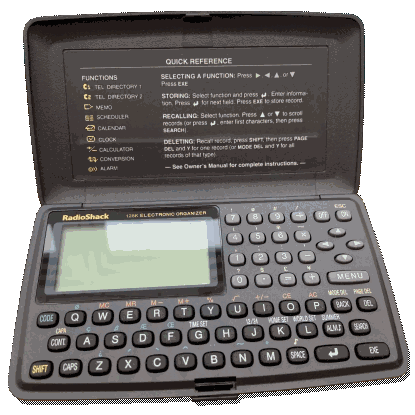
RadioShack 128K:
What
I ended up with was a 128K RadioShack model from a Tandy
shop; I think it must have
seemed like a good deal at
£49.99 when that would only buy
you a 64K organiser from Argos.
I
filled it with the names and
addresses of friends and
relatives, notes, and weekly
schedulings of what I wanted to
watch on TV by scouring through
the Radio Times (another British
stable, a TV guide). This was a
practice I adopted after staying
with my grandparents who would
take the time to highlight what
they each wanted to watch in
their TV guide; but back at home
I had to share our Radio Times
with three siblings, and my
parents, so instead I would
borrow it for half an hour (or
however long it took), schedule
in all what I wanted into my
Organizer, and return the guide
back to my mum, until the next
one arrived the following week.
Eventually I did actually fill
my 128K Organizer, because I
never deleted events after the
fact, and there was no "purge"
option (that I can recall).
Really that's all I ever used it
for. I filled it, and couldn't
bring myself to reset it, by
probing the little hole on the
back (something annoying kids
would do to other gadgets at
school...) Eventually the
batteries ran out (3 x CR2032 I
believe) and by that point the
cost of those batteries just
didn't seem worth it; the device
was already out of date and the
novelty had worn off. At some
point I dismantled the thing,
curious about how it looked
inside, and it never went back
together, so it went in the bin.
One thing I didn't like about
this particular organiser was
that the hinged cover didn't
fold all the way back, like to
double back underneath itself
like others could, and it seemed
like the little plastic lugs
that formed the hinge could be
easily snapped; I was careful
with it though and this
surprisingly never happened.
I
have fond memories of such
things, and times, as you can
probably tell; I wish I had just
boxed it away for the next 20
years, like I should have done
with everything else I ever
owned and ultimately chucked or
otherwise parted with.
Really
the device was a gimmick, just
as I think much of tech is.
There's a lot of these kinds of
organisers available for cheap
on ebay. More on this in a
moment.
Lotus
Organizer:
A
few years later, when I bought
my first Windows PC, running
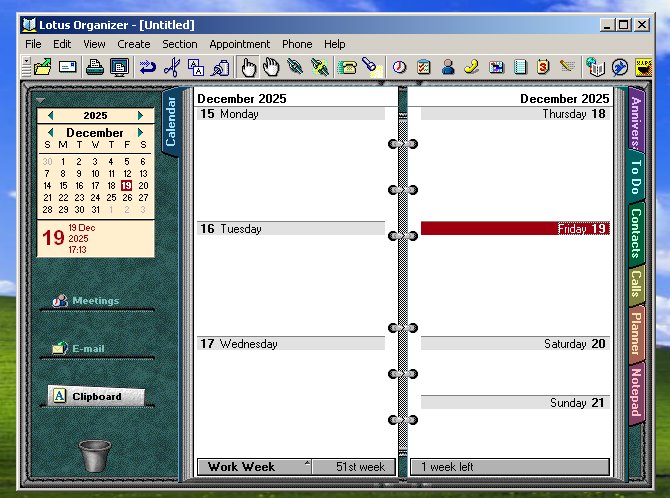
Windows 98, it came with Lotus
Smartsuite 1-2-3, which included
Lotus Organizer. I really liked
the aesthetic.
Sadly, with the software tied to
my computer, it wasn't much
practical use. I wish there
would be some modern day app
that had a similar aesthetic.
The
Compaq iPAQ:
In 2021 I acquired a
Compaq iPAQ
H3970 PDA selling for what
seemed like a good price. It was
deemed to be virtually brand new
and complete in its original box
that was just a bit worn.
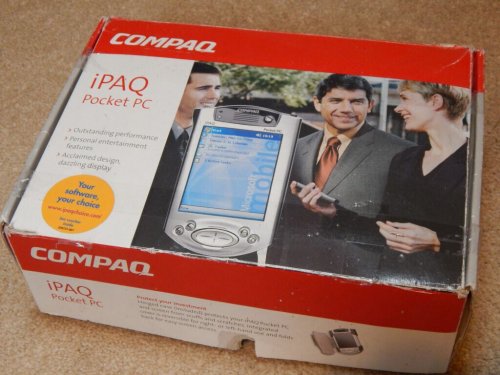
However, as I should perhaps
have expected, the battery was
not functioning. Seemingly it
was too old and had been left
for too long with no charge. The
seller agreed to partially
refund me when I pointed this
out and I hoped I might be able
to find a replacement battery
for it...
Sadly, nowhere seemed to have the
right battery.
It's a Li-Polymer 3.7V but has a
proprietary piece of circuitry
attached, likely for
power/charging/battery
regulation.
My
Options:
-
perhaps I could coax some charge
into the battery (this is quite
risky and should be done with
care)
- or, find a similar battery pack and transfer the necessary circuitry
I
also picked up a keyboard dock
that is pretty neat as the
keypad retracts [later found to
be faulty].
[Some time later...]
I
sourced a Li-Polimer 3.7V
battery of a size that would fit
the space occupied by the
original battery (which needed
some heat to remove). However,
rather than remove the charging
circuit from the original
battery (sorry I can't find a
picture of this), I piggy-backed the new
one in its place, and
surprisingly this worked. I now
had a fully functioning iPAQ.
During the course of some months
I intended to use the iPAQ for
daily scheduling and other
tasks, I was keen to dabble in
the OS, but really I simply
found myself playing endless
rounds of Solitaire to the point
the screen was getting marked by
the stylus from this act alone
(the top left corner where you
tap the stack of cards, and
'swipe' marks were now
noticeable on the display), so I
elected to list the device on
ebay.
[April 2024] "Sadly" my iPAQ got
sold. I'm sad that I never
really used it as I had
intended, but I was seeing how
prolonged use was going to add
to the wear of the screen which
was pristine when I received it.
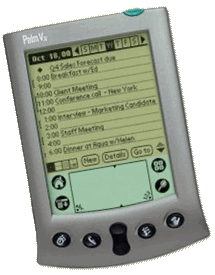 3Com PalmV: 3Com PalmV:
In around May 2024 I acquired a 3Com PalmV
(below). While with the Compaq
iPAQ I mostly only played solitaire
on it, before selling it on, the PalmV I
used for a while like the RadioShack Organizer; I scheduled
in some things and maintained a To
Do list, both things I find an
actual paper organiser and
simple little notebook to be far
more capable, cheaper, and most
notably, far quicker to deal
with - I can flick through pages
at ease and scribble things in,
or cross stuff out in seconds -
none of this tap-tap-tapping
away on an undersized little
keyboard or onscreen with a
stylus. Besides a gadget perhaps having a search
function, it is generally more
convenient to flick through
actual pages to find something,
the brain recalling a vague
scribble and/or the position on
a page. But alas, I'm still
drawn to the electronic
counterparts. Most
people now use their mobile/cell
phones in place of such
gadgetry, while at this time I preferred my
not-a-Filofax and dumb-phone.
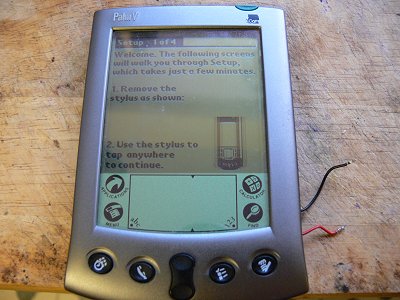
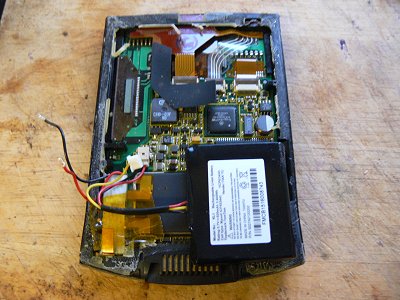
You'll notice the wires
protruding from the side of the
PalmV above. That's because it
came to me not working; the
battery was long since flat and
I had no dock to even attempt to
charge it. I found a Youtube
video showing how one guy had
removed the metal back of his
PalmV; it required a hairdryer
and pry tools. Using my heatgun
I attempted the same, but it
took quite a bit more effort
than was shown in that video due
to the adhesive used to glue the
back on. I think another
solution might be to instead use
WD-40 as a solvent. Hopefully I
hadn't bent the rear cover for
when it comes to putting that
back on.
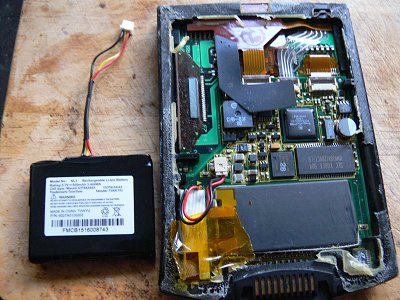
Anyway, I didn't have a direct
replacement for the battery, but
at this stage I just wanted to
test the device. It just so
happened that I had been given a
few old satnavs to test. One of
them was working but required
maps to be purchased for it
which just wasn't worth it so I
dismantled it to retrieve its
battery. It was a larger battery, but
looked like it could be used,
being the correct voltage
(3.7V). The plug was different,
it had three wires, but I was
able to slip out the little
metal contacts from the plastic
plugs and swap things over
(hence the stray wires, they're
from the old battery).

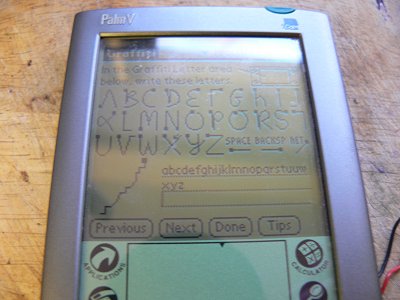
The
setup process first involves
calibrating the touch screen
with the stylus (something that
needs to be re-done every once
in a while), and then you get a
tutorial on writing using the
Palm's "Graffiti". It's a quirky
input method which on the Palm
has to be inputted into the
bottom section of the screen and
can vary with other devices that
have a similar feature, so if
you learn one, you might
struggle on another - It took me
a while to get to grips with it. You
can tap the bottom left of the
box to call up the onscreen
keyboard although somewhat
annoyingly you can't use both
methods at the same time and
have to close the keyboard to
input in the box again.
I
then used the PalmV until pretty
much that cobbled-together
battery ran out, since I had no way of recharging
it in the device, although I had been using it for a couple of
weeks and iin that time it was still above 75%.
Peter's Pilot Pages shares
the pin-outs for the dock, so
someone could potentially rig something
up to charge the device without
having a proper dock.
Casio
SF-8000 Digital Diary:
In June 2026 I got my hands on
one of these...

It was fully working and in its
original box, and importantly
included the user manual.
This Casio is an early version from
the 80s; quite an impressive piece of kit back in the day, and
stupidly expensive. Like my RadioShack Organizer I had in the
1990s with its 128K, that cost £50 and was a big Christmas
present. But for the Casio to be from the 80s with half the RAM,
must have cost £000s.
The time wasn't set correctly so I
had to try and figure out how to do that... and jeez it was
complicated. Reading the manual gave the impression that the unit
would have good time-keeping precision so I thought I would set an
alarm for the morning... that took half hour of
trial-and-error-button-pressing, and head scratching. In the
manual every process involves a specific and archaic sequence of
button presses.
The way I've come to understand it
is that the screen doesn't really convey much in the way of a user
interface as we are now more familiar with, but is more of a raw
output of the contents of memory - there aren't really headings or
icons (as my later digital organizer in the 1990s had), although
the calendars and daily schedule are somewhat graphical. Instead,
all the buttons form the various commands and functions, and
you're pretty much shifting that data about on the screen;
therefore you need the manual in order to know and learn the
sequence of commands in order to get anything done, and then a lot
of practice.
There's basically a chapter in the
manual devoted to each of the sections of the device. Page 98, for
the 'Schedule Keeper' amused me when it begins with "Entering data
[here] is actually quite simple....", as if it's more
straightforward than the preceding sections (it's not!). The
remainder of that chapter is 16 pages...
One of the fun quirks here is you
are instructed, as one method, to ender the Calculator mode in
order to ender a date that you wish to search for in the
Calendar/Schedule Keeper. Indeed, if wanting to search for a phone
number in the Telephone directory, for example, you have to
remember that names are inputted/stored before them and thus such
a search has to include a blank field for name, and then the
number, with a "Combine" command between them. Or if you search
for Joe Blogs by searching for "j" or "B", it'll return no
results.
The one thing I feel this model
lacks is a backlight.
While the unit was initially
somewhat frustrating to use, I realised it's largely down to being
a "difference way of doing things". Modern devices are generally
"intuitive" and have a common, and therefore, familiar interface
(not to mention often being touch screen and utilizing an app).
This Casio is from a different era and I can appreciate that my
brain just wasn't grasping the process. This is intriguing me,
like being faced with all of the buttons on a scientific
calculator; not having the foggiest idea of what they're all
about, but wanting to know. So, I wanted to get to grips with this
Casio organiser, and become that suave person I would have looked
at in awe as a child, coolly inputting things into my neat gadget,
like a man of the future... whilst being stuck in the past!
I spent some evenings working my
way through the manual, section by section, carrying out the
example procedures. Now it's July and I'm amusing myself by
inputting any key things I need to schedule.
The device features a data transfer
port, for either communicated with compatible devices via a short
cable (which I don't have), or with a desktop computer with
additional gadgetry which the manual explains.
I looked on ebay and may have come
across something that might work, I'm just waiting for it to
arrive...
|