|
Green Bank telescope:
The Robert C. Byrd Green Bank
Telescope (GBT) in Green Bank,
West Virginia, US is the world's
largest fully steerable radio
telescope.
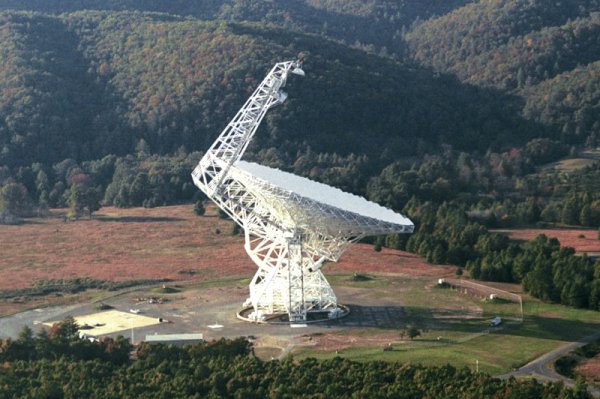
With a 100-meter-class
collecting dish, GBT is one of
the largest fully steerable
single-dish radio telescopes in
the world. Its sensitivity and
wide frequency coverage make it
ideal for detecting faint radio
signals from pulsars and other
astrophysical sources.
In Einstein@Home, the GBT
provides data for pulsar
searches, particularly for
binary pulsars. The volunteer
computers analyze GBT data to
identify the characteristic
periodic radio pulses of neutron
stars, including those in tight
orbits where the signals are
Doppler-shifted by orbital
motion. Alongside Arecibo and
MeerKAT data, the GBT has
contributed to discovering
hundreds of pulsars, helping to
expand our understanding of
neutron star populations,
millisecond pulsars, and exotic
binary systems.
-
Neutron stars are the
incredibly dense remnants of
massive stars that exploded as
supernovae. They typically have
a mass about 1.4 times that of
the Sun, compressed into a
sphere roughly 20 kilometers (12
miles) across. This extreme
density means a neutron star’s
matter is packed so tightly that
a sugar-cube-sized piece would
weigh billions of tons on Earth.
Neutron stars often have very
strong magnetic fields and can
spin rapidly, emitting beams of
radiation from their magnetic
poles — these are observed as
pulsars when the beam sweeps
past Earth.
-
Pulsars in Tight Orbits &
Doppler Shifts; Some pulsars
are in binary systems with
another star, sometimes in tight
orbits, meaning the two stars
orbit each other very quickly.
Because the pulsar is moving
toward or away from Earth during
its orbit, the pulses we detect
are Doppler-shifted (when the
pulsar moves toward us, the
pulse frequency appears slightly
higher, and when it moves away,
the frequency appears lower.)
This effect makes the timing of
the pulses appear to vary
slightly, which complicates the
search but also provides crucial
information about the pulsar’s
orbital period, velocity, and
companion mass. Einstein@Home’s
computing power is used to
analyze these shifts and
identify pulsars in such dynamic
binary systems.
|