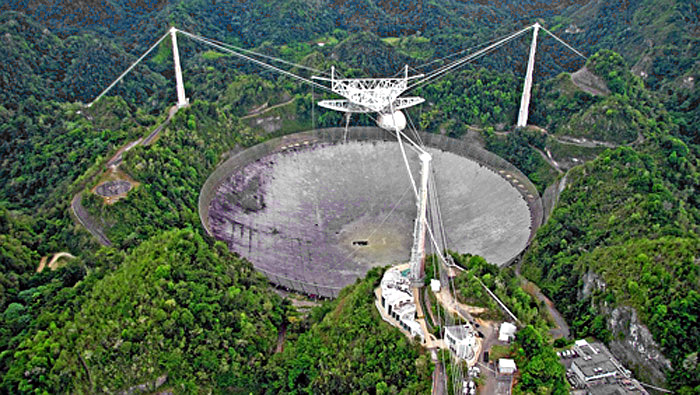
The Arecibo Observatory was a
radio telescope in Arecibo,
Puerto Rico.
The observatory
consisted of a 305 m (1,000 ft)
spherical reflector dish built
into a natural sinkhole, a
cable-mount steerable receiver
mounted 150 m (492 ft) above the
dish, and several radar
transmitters for emitting
signals. For more than 50 years,
the Arecibo Observatory was the
world's largest single-aperture
telescope.
The observatory was damaged
by Hurricane Maria in 2017 and
was affected by earthquakes in
2019 and 2020. After cables
broke the
support structure for the
suspended platform crashed down
into the dish. The site is
likely to be decommissioned.
Arecibo was primarily used
for research in radio astronomy,
atmospheric science, and radar
astronomy, as well as for
programs that search for
extraterrestrial intelligence (SETI).
The Arecibo Observatory
played a central role in
Einstein@Home’s pulsar searches,
providing high-quality radio
data that enabled volunteers’
computers to discover new
pulsars. Using surveys such as
the PALFA Survey, Einstein@Home
analyzed Arecibo data to find
hundreds of pulsars, including
many millisecond and binary
systems. These discoveries have
been crucial for advancing our
understanding of stellar
evolution and testing
fundamental physics, with
Arecibo’s sensitivity allowing
the detection of faint and
distant pulsars that would
otherwise have gone unnoticed.
Even after its closure in 2020,
the pulsars found through
Arecibo data continue to be
studied and monitored via
volunteer computing,
highlighting its lasting impact
on the project.
Millisecond pulsars
are neutron stars that spin
extremely rapidly, often
hundreds of times per second.
They are usually “recycled”
pulsars that have gained angular
momentum by accreting matter
from a companion star over
millions of years. Because of
their incredible rotational
stability, millisecond pulsars
serve as precise cosmic clocks,
useful for testing fundamental
physics and detecting
gravitational waves.
Binary pulsars are
pulsars that orbit another star,
which can be a neutron star,
white dwarf, or normal star.
Their orbital motion causes the
pulsar’s signals to shift in
frequency, allowing astronomers
to measure orbital parameters
and test General Relativity.
Many millisecond pulsars are
also in binary systems,
combining rapid spin with
orbital motion, making them
particularly valuable for
astrophysics research.
The PALFA Survey (Pulsar
Arecibo L-band Feed Array) was a
major radio pulsar survey
conducted using the Arecibo
Observatory. Launched in 2004,
its primary goal was to discover
new pulsars, particularly
millisecond and binary pulsars,
by scanning the Galactic plane
in the L-band (1.4 GHz).
PALFA used the Arecibo L-band
Feed Array (ALFA), a multi-beam
receiver, which allowed the
telescope to cover large areas
of the sky efficiently. The
survey’s high sensitivity
enabled it to detect faint and
distant pulsars that other
surveys might miss. Many of the
pulsars discovered by PALFA,
including exotic systems like
binary and millisecond pulsars,
have been analyzed by
Einstein@Home to search for new
pulsars in binary systems using
volunteer computing.
The Arecibo observatory is a familiar
site; it has had several
appearances in film, gaming and
television productions, such as
for the climactic fight scene in
the James Bond film GoldenEye.