
 |
 |


|
|
|
|
|
Internet Regulation - From Cookies
to Compliance Due to residing in the UK, I've been subjected to a few internet annoyances over the years. It's especially sad because I considered the internet to be open and free in the early years (late nineties/early 2000s). One such annoyance has involved the utterly pointless irritation of Cookie Requests and GDPR which plague any of us (UK/EU citizens) who visit a website for the first time (or the first time on a fresh clean web browser). From what I have seen, most people are oblivious to what a cookie request notice actually means and they click either option, Accept or Decline, but probably more often "Accept All Cookies" because that's surely like agreeing to Ts&Cs, which "of course you need to do, otherwise you can't get in... right?" Furthermore, there are websites that appear to comply with the cookie request notice but make the opting out process as painful as possible. 2025 though, saw the rollout of the UK's so-called Online Safety Act, or more accurately it saw the rollout of reactions to the Act, usually in the form of notices presented to visitors in the UK. I list some examples below and I do so to highlight these platforms as generally complicit in what will surely become the negative knock-on effects of the Act, such as a step along the path of Digital IDs, not to mention the potential for similar Acts to be rolled out in other countries.
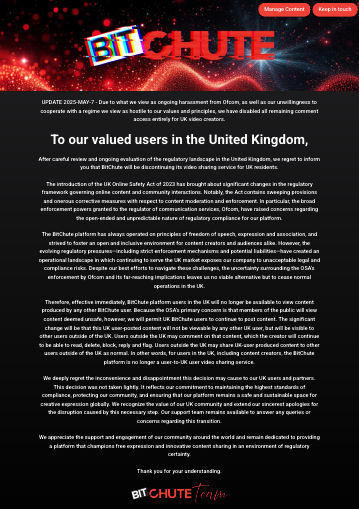
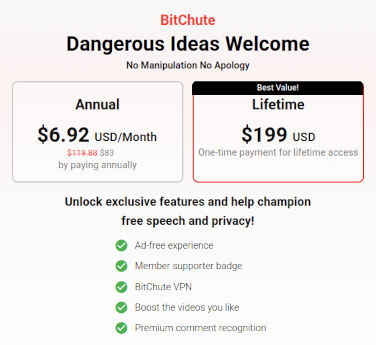
Bitchute, in a PDF (above) dated May 2025, begin with "Due to what we view as ongoing harassment from Ofcom, as well as our unwillingness to cooperate with a regime we view as hostile to our values and principles, we have disabled all remaining comment access entirely for UK video creators." [my emphasis] highlights that the contradiction that they are cooperating! The very Act doesn't want them to be making their content accessible to anyone in the UK (except to those preparing to comply with a request for ID). Bitchute illustrates that they lack values and principles of any note. They go on to say "To our valued users in the United Kingdom..." which is an insult because they clearly don't value us, since they're not prepared to stand up for us. Their hypocrisy is apparent when you read their subscription offers:
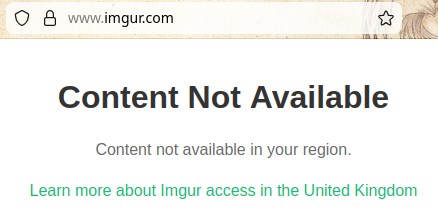
Further irony comes in the form of a VPN which is included with their deals; and a VPN is all that is needed to circumvent the block. The weird thing is that even Youtube hasn't complied with the Act, although I'd recommend Rumble as being a video platform that supports free speech. Next up is Imgur. This image-sharing platform is once I had been using while at the same time despising; the left-wing nature of the feed when first arriving at the site was full of left-wing memes attacking anything that might be considered right-wing, but I used the siteregardless just so I could upload the occasional image to share with someone else. Imgur put a stop to this with their stance on the Online Safety Act:
Clicking "Learn more..." provides next to no explanation, only ways to have your data removed. Imgur clearly don't even have the mind to object. While I've been able to use an alternative site for my needs, the block has revealed to me just how many people share and embed images hosted on imgur, which ruins many websites on Neocities as I have tried to point out [here].
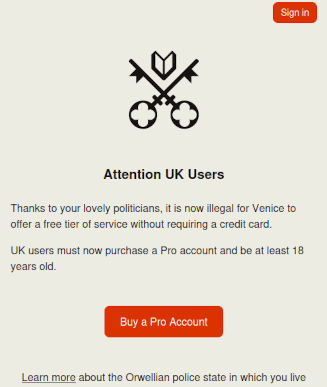
A surprising block came from Venice AI, which was pushed as a tool more accurate and honest than the likes of ChatGPT:
They claim it's now illegal for them to provide access to their free service (I'd never actually used it before). In actuality I think the converse is true of these platforms; they can't legally acquire customers in the UK without obtaining ID, so why bother providing the free access unless they agree with that? Attempting to use a free VPN to circumvent this resulted in the following:
This is due to the number of people using each of the available VPN connections and to Venice's systems these must look like one user. There are arguments against using a VPN for general day-to-day use, so I typically only fire one up when I feel the need. VidLii were one website I landed on which blocked me but actually encouraged me to use a VPN; it was basically like saying "if we don't know you're from the UK, then you're allowed in." For how long will VPNs remain legal to use by residents of the UK though, since they have been banned in some other countries? This will of course move the legality, and the risk of penalty, to the user, and away from the websites. SpaceHey are a vague in their notice, which appears more of a generic notice which they can deploy for a variety of reasons. "We don't have the resources to comply..." then don't?
And what of protecting children? I think the onus should be on the parents; the internet has always been a land of risks of trashy content at any turn. All parents today know full well what is out there online, and having all now grown up with the internet, have no claim of tech-ignorance. But really I don't think any of this is about that; it's about government control and censorship. Returning to the first complaint I raised with regards to Cookies and GDPR, the latter was presented to us as a means of improving our privacy online (if you believe that), but the push for Digital IDs which would allow governments (or anyone who gains access to that data) the means of tracking our activities online (a lack of privacy). A final annoyance is that by setting a VPN to the UK doesn't appear to allow those outside of the UK from seeing a site how we in the UK do, which might be beneficial for testing purposes.
|
|
|


 I
don't actually see how a website in a foreign country should feel
threatened by the requests of a foreign government that should have no
jurisdiction over them. I suppose it might come down to the banking side
of things because it might be deemed that money has been taken for
illegal services, and thus clawed back. In extreme cases, those
responsible for such platforms might be at risk of arrest should they
enter the UK. But why should a foreigner be expected to know the laws of
another country if not actively trading there?
I
don't actually see how a website in a foreign country should feel
threatened by the requests of a foreign government that should have no
jurisdiction over them. I suppose it might come down to the banking side
of things because it might be deemed that money has been taken for
illegal services, and thus clawed back. In extreme cases, those
responsible for such platforms might be at risk of arrest should they
enter the UK. But why should a foreigner be expected to know the laws of
another country if not actively trading there?