|
Day 15, Yesterday's day included
a map on which were marked some sites of interest; some
chambered cairns, a standing stone, and a burial chamber. Those
sites were all within easy walking distance of one
another, but there are many such points of interest here on
Anglesey (north-west Wales, UK) where I live, and I've been
intrigued by them ever since I've lived here. It also intrigues
me when I spot the same sorts of things elsewhere, as I have
done this week on DeviantArt.
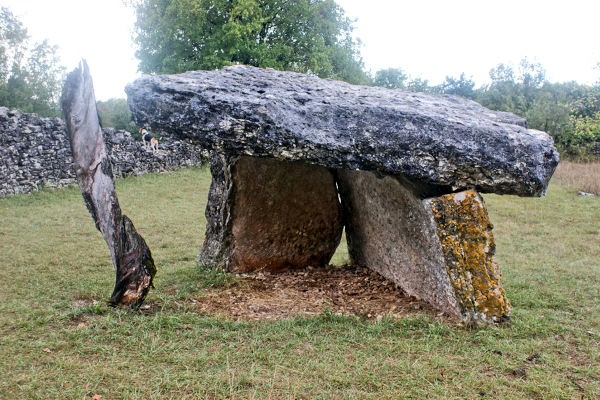
Above image by FEB43 on DeviantArt: France dolmen in Vendee.
 In
the above image the 'pillar' to the left appears to be a tree,
and one that had been struck by lightening, which intrigues me
further [another
angle]. Sometimes I have explored these kinds of
constructions and found the resting stone to be supported on the
smallest of points (three) of the stones beneath; to think of
all that weight and pressure bearing down, yet it rests there
calmly. The piezoelectric effect comes to mind, and some (see
The Giza Powerplant by Christopher Dunn) have postulated that
the Great Pyramid at least, was possibly a great machine. In
the above image the 'pillar' to the left appears to be a tree,
and one that had been struck by lightening, which intrigues me
further [another
angle]. Sometimes I have explored these kinds of
constructions and found the resting stone to be supported on the
smallest of points (three) of the stones beneath; to think of
all that weight and pressure bearing down, yet it rests there
calmly. The piezoelectric effect comes to mind, and some (see
The Giza Powerplant by Christopher Dunn) have postulated that
the Great Pyramid at least, was possibly a great machine.
Piezoelectricity is the ability of certain materials to
generate an electric charge in response to applied mechanical
stress, such as pressure, bending, or vibration, and
conversely, to deform when subjected to an electric field.
This phenomenon, derived from the Greek word "piezein" meaning
"to press" or "squeeze," was first discovered in 1880 by
French physicists Jacques and Pierre Curie, who observed
electric charges on crystals like quartz [present in some
megalithic rocks], tourmaline, and Rochelle salt when
mechanically stressed. The effect is reversible: the direct
piezoelectric effect converts mechanical energy into
electrical energy, while the converse effect converts
electrical energy into mechanical strain, enabling
applications in sensors, actuators, ultrasound generation, and
energy harvesting. Materials exhibiting piezoelectricity must
lack centrosymmetry and are typically insulators, including
natural crystals like quartz. - AI generated description.
In the next photograph, taken by the same person, is another
example to be found in Vendee, France, but this time partially
submerged.

Were all of these submerged at some point and formed the
other kind of site labelled as a burial mound; perhaps excavated
by treasure hunters, or unearthed by natural erosion?

Here's a site I visited on my cycling trip to Scotland in 2016
(my trusty steed is there on the left).
Some sites have been pieced back together after suffering
collapse; sometimes this is done in a not so agreeable manner; I
would call out Newgrange in Ireland as an example here. Some
people theorise that some mounds are in fact not mounds, but
disguised pyramids, and therefore sharing a similar purpose to
those grand structures found more obviously in Egypt, South
America, and China.
Are some of the singular standing stones simply left as such
by the flow of ice from an ice age? When visiting a great circle
of stones (~64) up in Scotland some years ago I had a strong
feeling that these represented a gathering of people, perhaps
the last of a tribe; it was quite moving. Since then I get a
similar suspicion when viewing other similar arrangements.
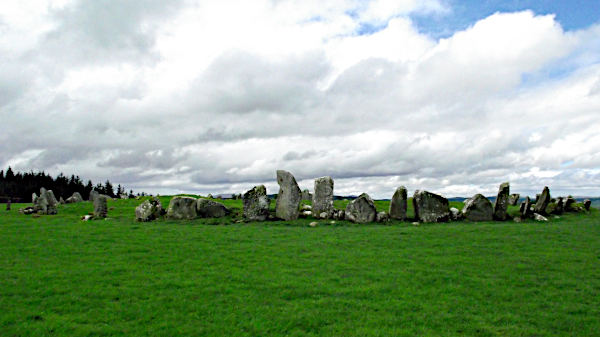
Beltany Stone Circle which I visited in 2019.
|